1. Net area and volume in place
For a wall, multiply the length by the height and subtract the openings. Multiply the area by the thickness. A wall of hollow blocks is not solid throughout: multiply by its solid share.
Using the tool step by step
The numbered marks on the screenshots follow the order in which you use the tool. The fields are filled with an example.
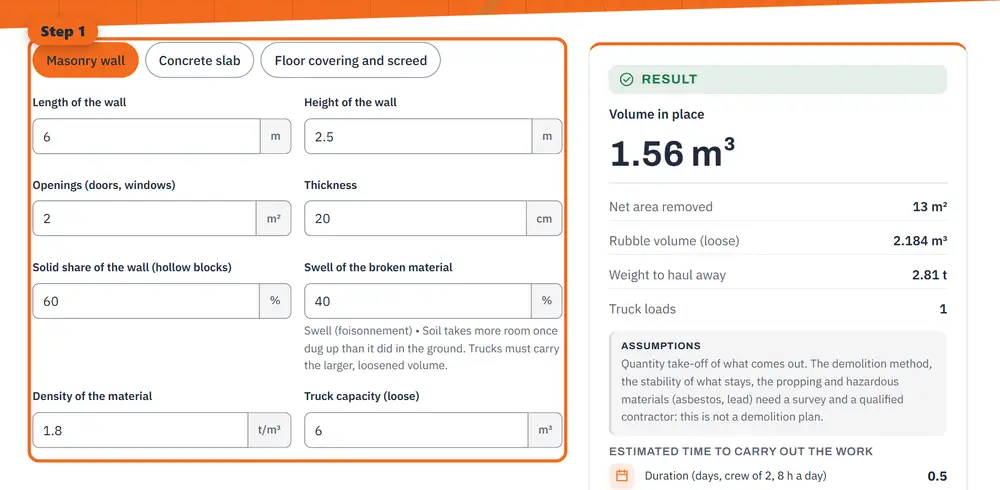
Step 1 Enter your values: dimensions, materials and options. 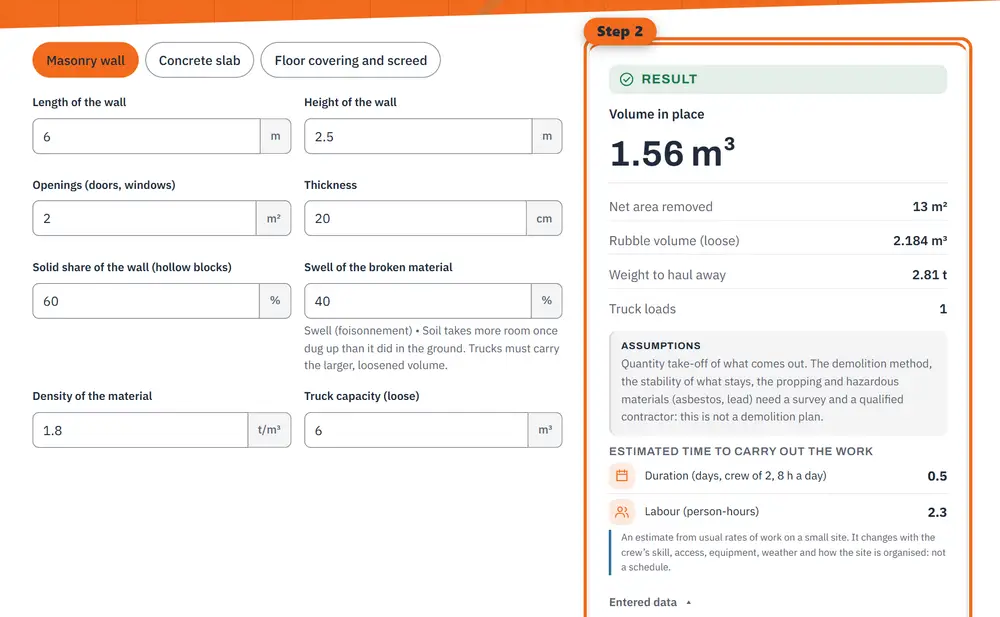
Step 2 Read the results: quantities, costs and estimated durations, updated as you type. 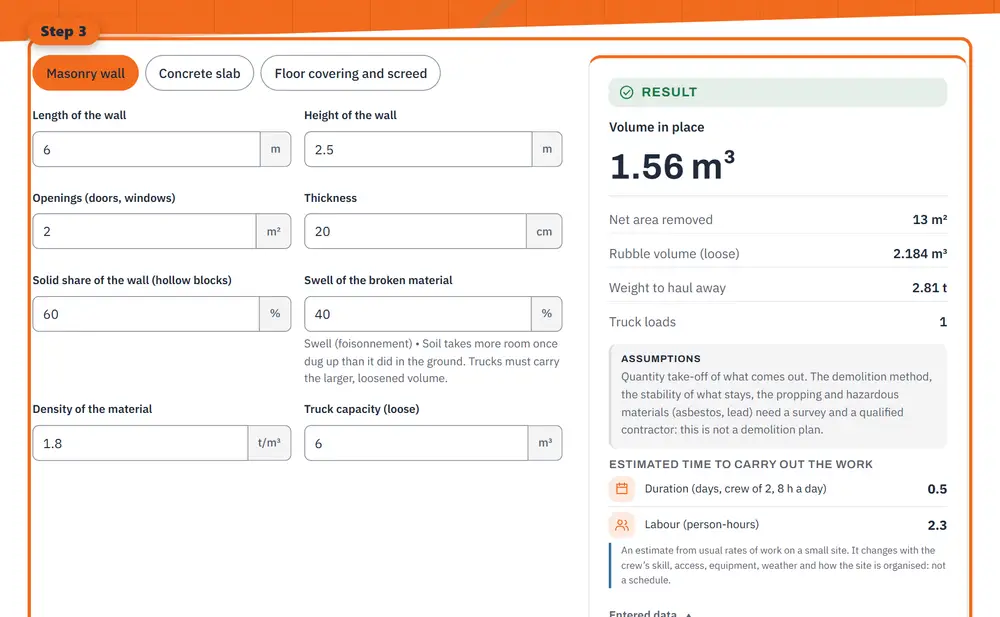
Step 3 Print, copy the result or save it as a PDF.
2. Swell, weight and truck loads
Broken material takes more room than in place: increase the volume by the swell. The weight is the volume in place times the density. The loads are the loose volume divided by the capacity of a truck, rounded up.
Worked example: wall of 20 × 2.5 m, 5 m² of openings
Thickness 20 cm, 60 % solid, swell 40 %, density 1.8 t/m³, truck of 6 m³:
- Net area 20 × 2.5 − 5 = 45 m².
- Volume in place 45 × 0.20 × 0.60 = 5.400 m³.
- Loose volume 5.4 × 1.40 = 7.560 m³, so 7.56 / 6 = 1.26, i.e. 2 truck loads.
- Weight 5.4 × 1.8 = 9.72 t.
Concrete slab of 60 m², 15 cm thick
Swell 40 %, density 2.4 t/m³, steel 80 kg/m³, truck of 6 m³:
- Volume in place 60 × 0.15 = 9.000 m³, loose 12.600 m³.
- Truck loads: 12.6 / 6 = 2.1, so 3.
- Weight 9 × 2.4 = 21.60 t. Steel recovered 9 × 80 = 720.00 kg.
What this does not cover
The count does not plan the demolition, check the stability of what stays or deal with hazardous materials such as asbestos. These need a survey and a qualified contractor.
General information, checked at the date shown. It does not replace advice from a professional for your situation.