1. Volume in place
Volume (m³) = length × width × depth. If you dig wider than the footing or wall to work in, add the working space on each side to the length and the width.
Using the tool step by step
The numbered marks on the screenshots follow the order in which you use the tool. The fields are filled with an example.
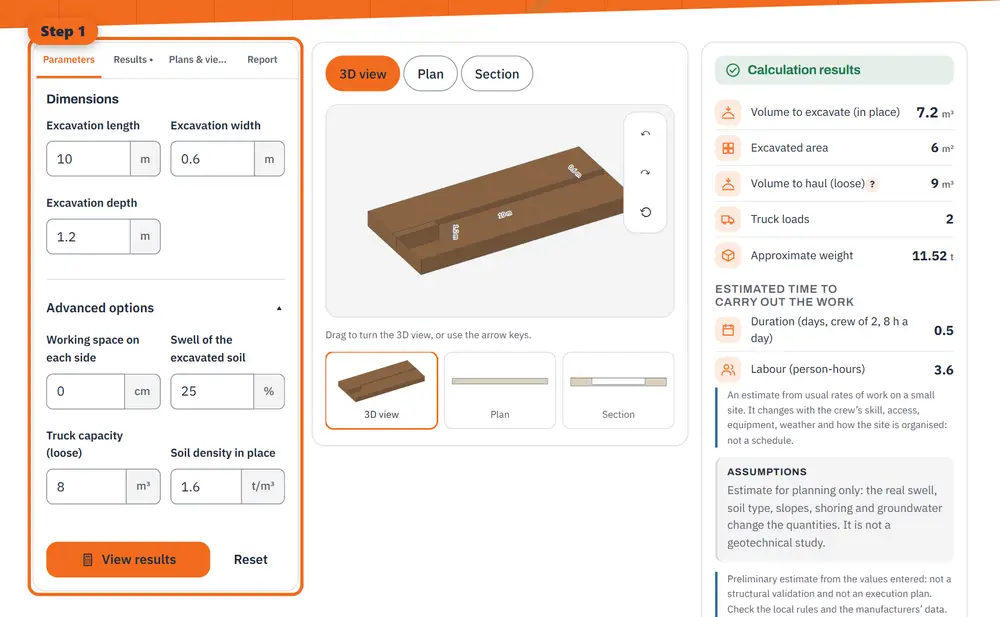
Step 1 Enter your values: dimensions, materials and options. 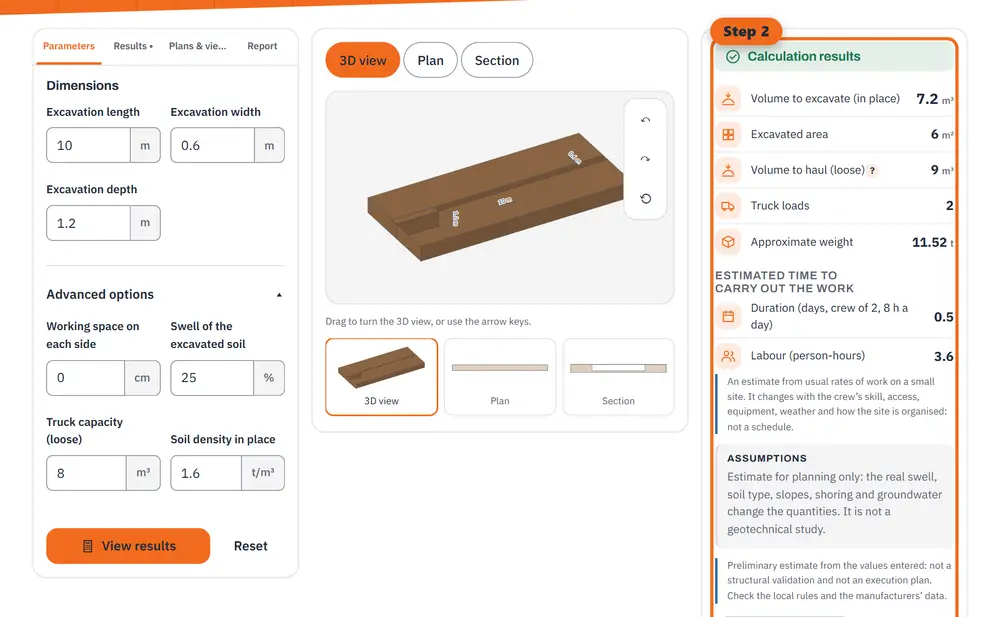
Step 2 Read the results: quantities, costs and estimated durations, updated as you type. 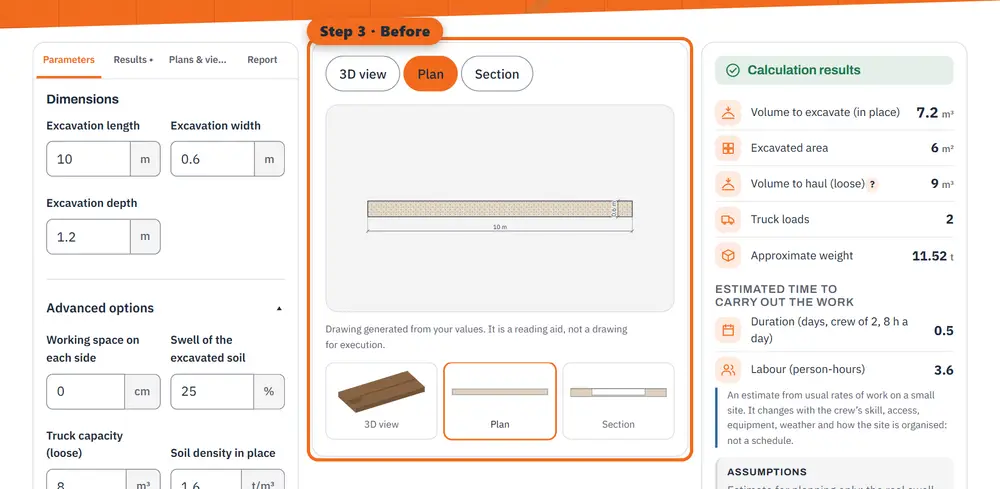
Step 3 Before: the plan of the work to be built, with its dimensions. 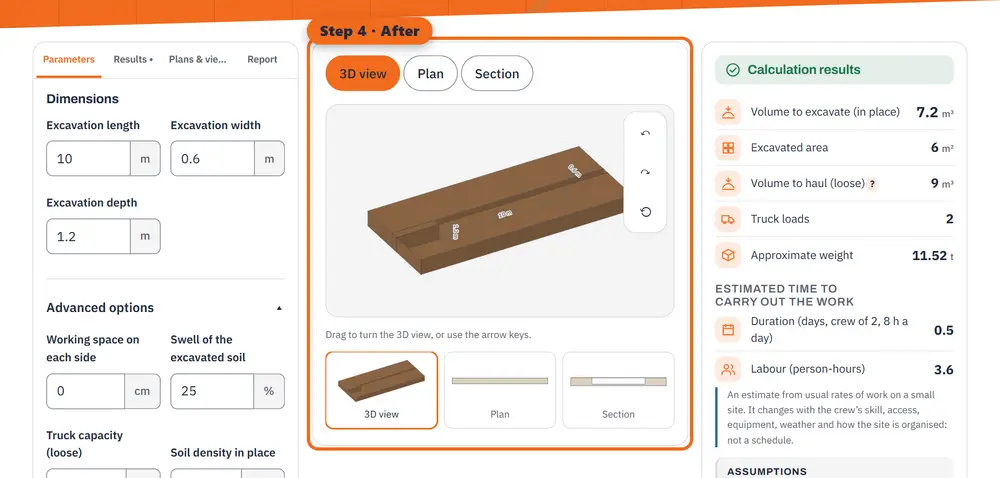
Step 4 After: the 3D rendering of the finished work (an illustration made by the tool, not a photo).
2. Swell: volume to haul
Loosened soil takes more room than it had in the ground. Multiply the in-place volume by (1 + swell). The increase depends on the soil, often 15 to 40 %: measure or ask for your own soil, because the figure moves the number of loads.
- Trucks carry the loose volume: use it to count the trips.
- Backfill that is compacted goes the other way: it takes less room than the loose soil.
Worked example: 10 m × 8 m, 1.2 m deep
10 × 8 × 1.2 = 96 m³ in place. With 25 % swell: 120 m³ to haul.
- With an 8 m³ truck: 120 ÷ 8 = 15 loads.
- At 1.6 t/m³ in place, about 153.6 tonnes.
What this does not cover
The estimate assumes straight sides. Slopes, shoring, steps, rock, groundwater, access and disposal rules change the quantities and the cost. It is a planning estimate, not a geotechnical study or a foundation design.
For the concrete of the footings that go in the pit, use the concrete calculator.
General information, checked at the date shown. It does not replace advice from a professional for your situation.