1. Count the points
List the light points, the sockets and the switches of every room. Flush boxes: one per point.
Using the tool step by step
The numbered marks on the screenshots follow the order in which you use the tool. The fields are filled with an example.
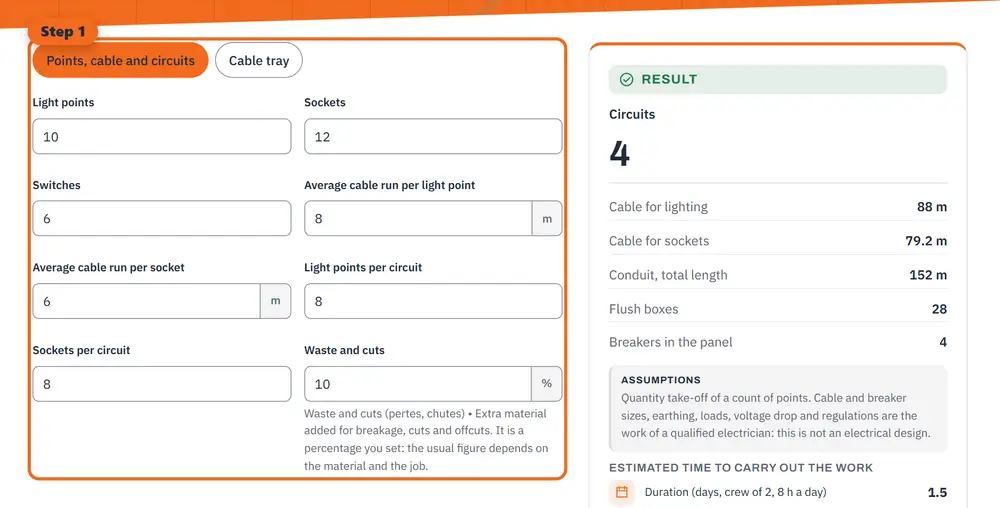
Step 1 Enter your values: dimensions, materials and options. 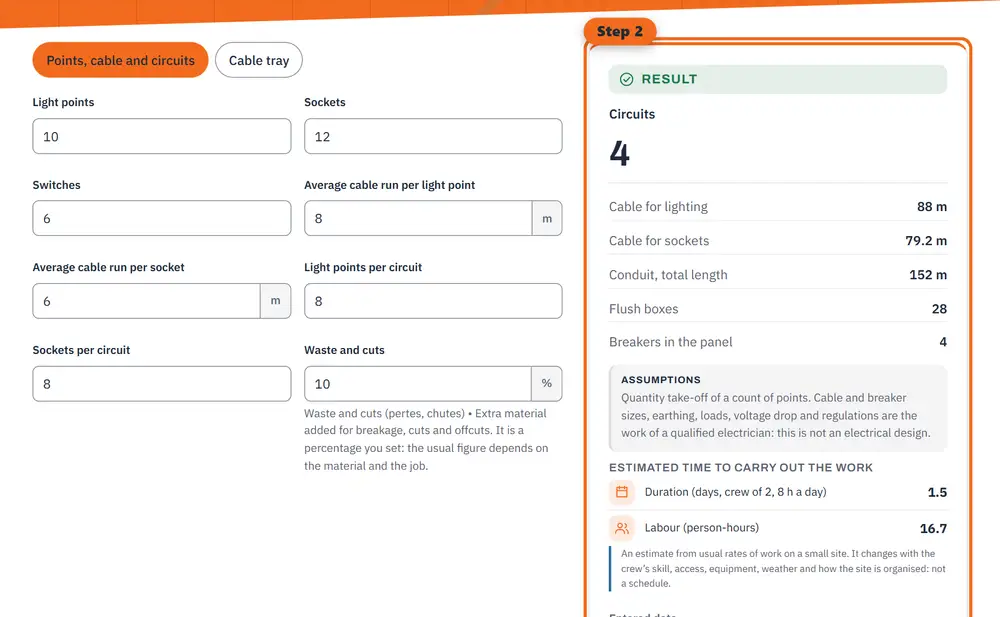
Step 2 Read the results: quantities, costs and estimated durations, updated as you type. 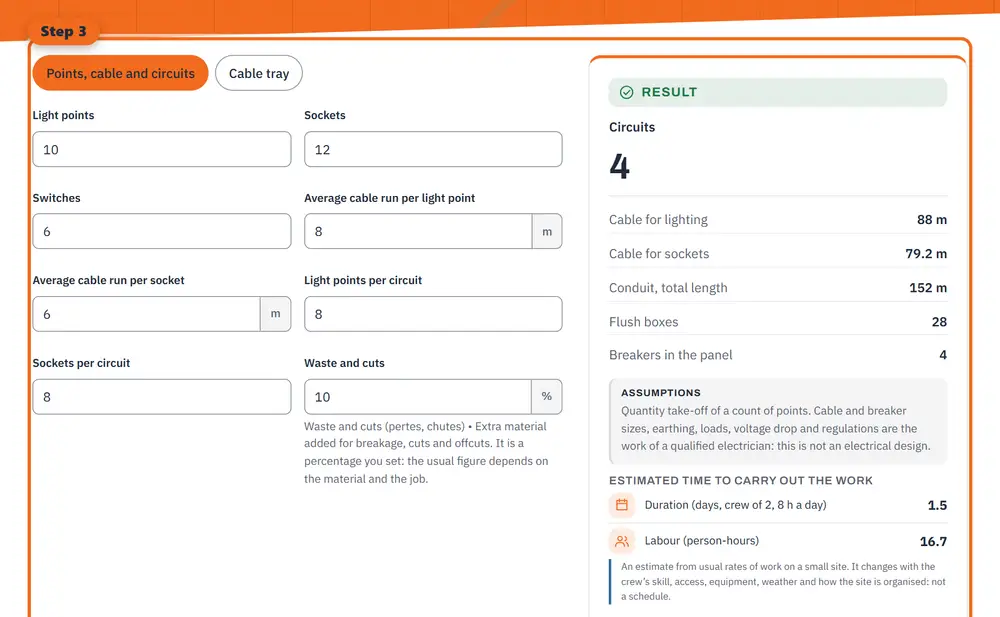
Step 3 Print, copy the result or save it as a PDF.
2. Cable and conduit
Multiply the number of light points by the average cable run per light point, and the same for sockets. Add the waste to get the cable to buy. The conduit is the same run without waste.
3. Circuits and breakers
Divide the light points by the number a circuit takes and round up; do the same for the sockets. The circuits are the sum, with one breaker each.
Worked example: 10 lights, 12 sockets, 6 switches
Average run 8 m per light point and 6 m per socket, 8 points per circuit, 10 % waste:
- Lighting cable: 10 × 8 = 80 m, with waste 88.00 m.
- Socket cable: 12 × 6 = 72 m, with waste 79.20 m. Conduit 152.00 m.
- Boxes: 10 + 12 + 6 = 28.
- Circuits: 10 / 8 → 2, and 12 / 8 → 2, so 4 circuits and 4 breakers.
Cable tray run of 30 m
Bars of 3 m, brackets every 1.5 m, covers, 10 % waste:
- Bars: 30 × 1.10 / 3 = 11.
- Brackets: 30 / 1.5 = 20, plus 1 for the end, so 21.
- Covers: one per bar, so 11.
What this does not cover
The count does not size cables or breakers, check earthing or voltage drop, or apply any regulation. That is the work of a qualified electrician.
General information, checked at the date shown. It does not replace advice from a professional for your situation.