1. The area to paint
Measure the room in metres:
- Walls: (length + width) × 2 × ceiling height.
- Deduct the openings: about 1.8 m² per door and 1.5 m² per window (measure yours if they are larger).
- Ceiling, if you paint it: length × width.
Using the tool step by step
The numbered marks on the screenshots follow the order in which you use the tool. The fields are filled with an example.
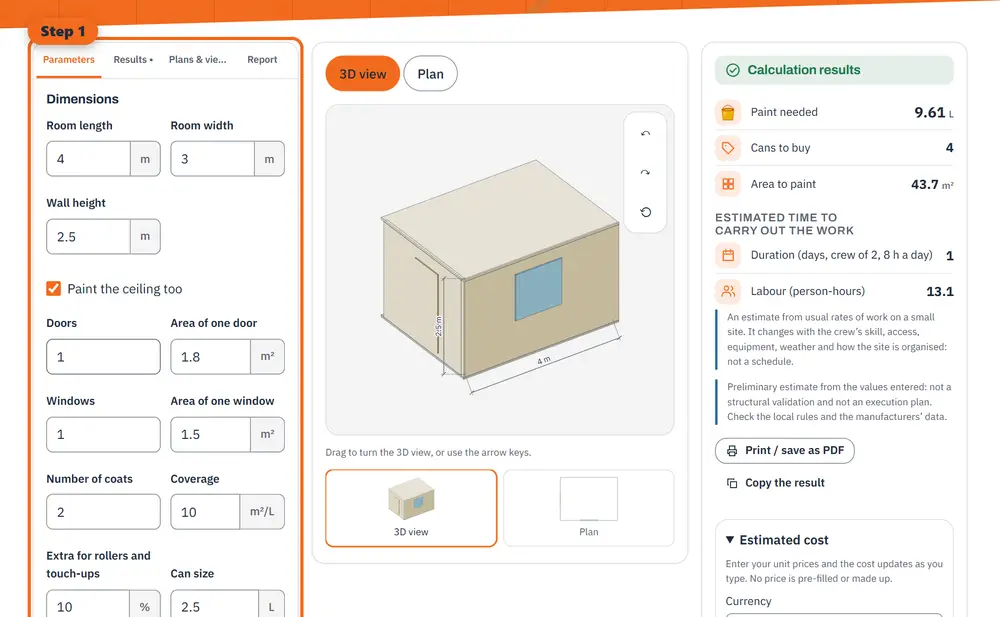
Step 1 Enter your values: dimensions, materials and options. 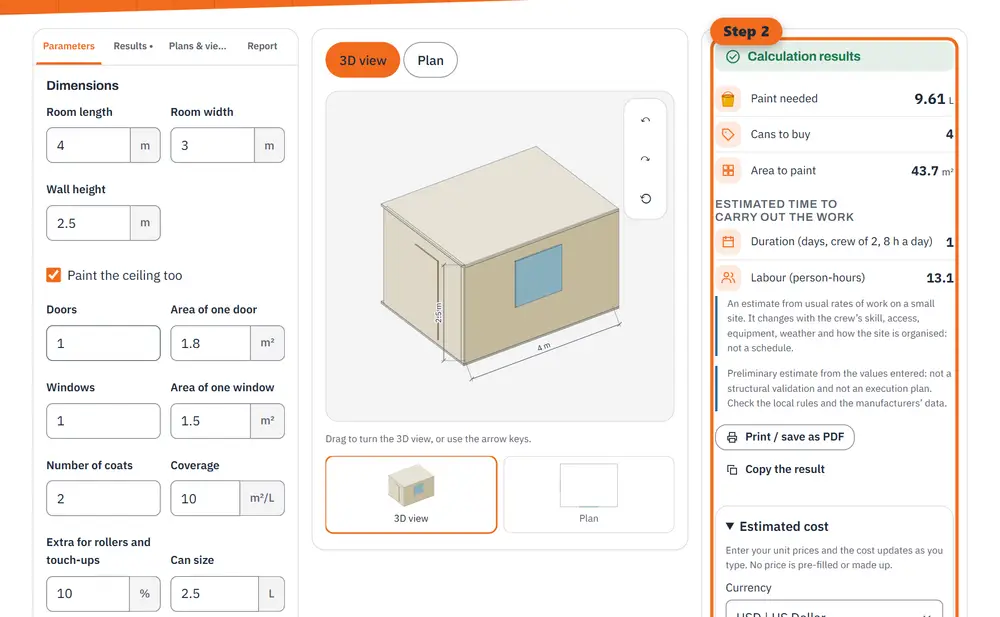
Step 2 Read the results: quantities, costs and estimated durations, updated as you type. 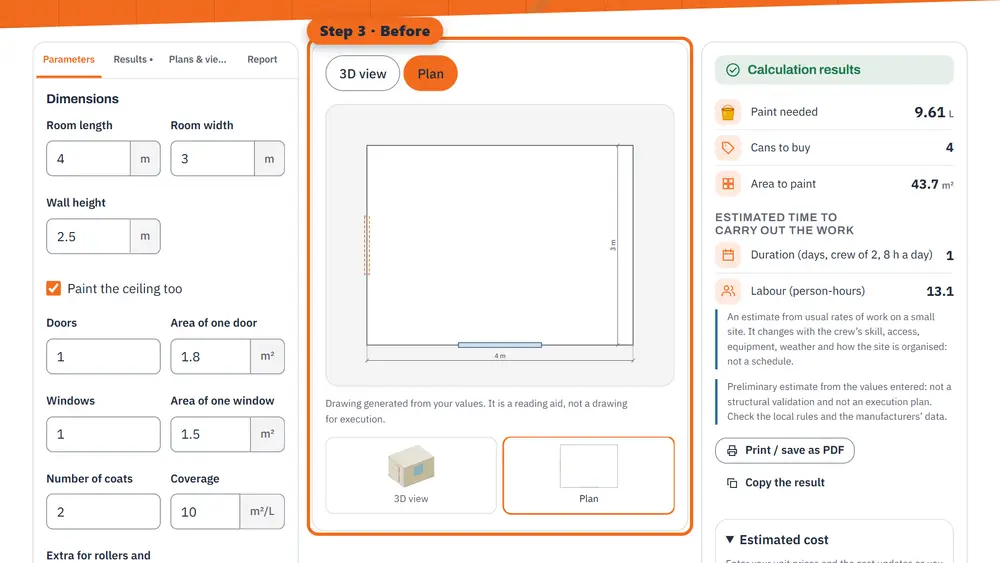
Step 3 Before: the plan of the work to be built, with its dimensions. 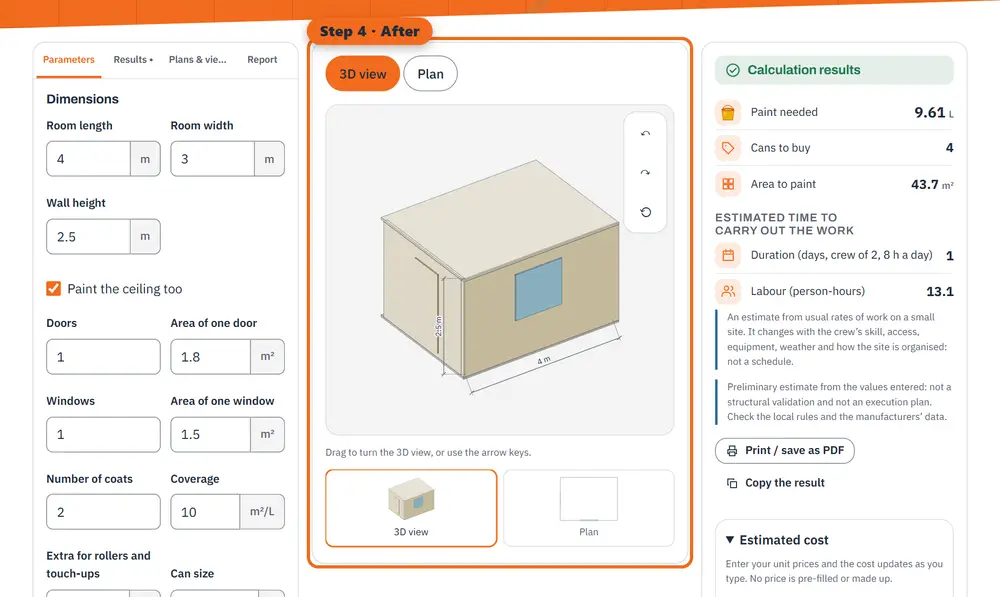
Step 4 After: the 3D rendering of the finished work (an illustration made by the tool, not a photo).
2. From area to litres
Litres = area × number of coats ÷ coverage, plus 10 % for the roller, touch-ups and absorbent walls. Two coats are the norm; a new plaster or a strong colour change may need a primer or a third coat.
The coverage (m² per litre) is printed on the can: often around 10 m²/L for a wall emulsion, less on rough or porous surfaces.
Worked example: a 4 × 3.5 m bedroom
Ceiling height 2.5 m, one door and one window, two coats at 10 m²/L:
- Walls: (4 + 3.5) × 2 × 2.5 = 37.5 m²; minus 1.8 + 1.5 = 34.2 m² to paint.
- Paint: 34.2 × 2 ÷ 10 = 6.84 L, plus 10 % = about 7.5 L.
- In 2.5 L cans: 3 cans give exactly 7.5 L, too tight: take 4, or one 10 L can.
- Ceiling as well: 14 m² × 2 ÷ 10 + 10 % = about 3.1 L more (ceiling paint).
Good habits
Buy all the cans of a colour at once, from the same batch, and mix them in a bucket if you open several. Keep a little paint, labelled with the room, for later touch-ups.
Doing the floor too? The tile calculator gives the number of tiles and boxes for the same room, waste included.
General information, checked at the date shown. It does not replace advice from a professional for your situation.