The terms
Four quantities are needed to calculate a staircase, and they are often mixed up:
- Riser height (rise per step): the vertical distance between two consecutive treads.
- Tread depth (going): the horizontal depth of the tread, measured on the walking line.
- Total rise: the height to climb, from the finished floor below to the finished floor above.
- Stride: the length of a comfortable step, made up of the riser and the tread.
Using the tool step by step
The numbered marks on the screenshots follow the order in which you use the tool. The fields are filled with an example.
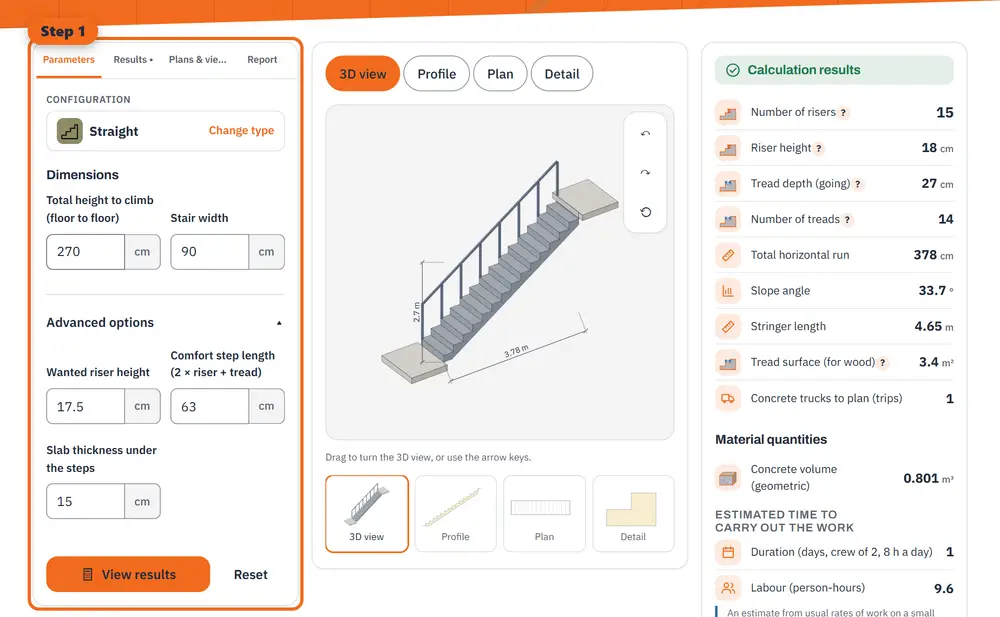
Step 1 Enter your values: dimensions, materials and options. 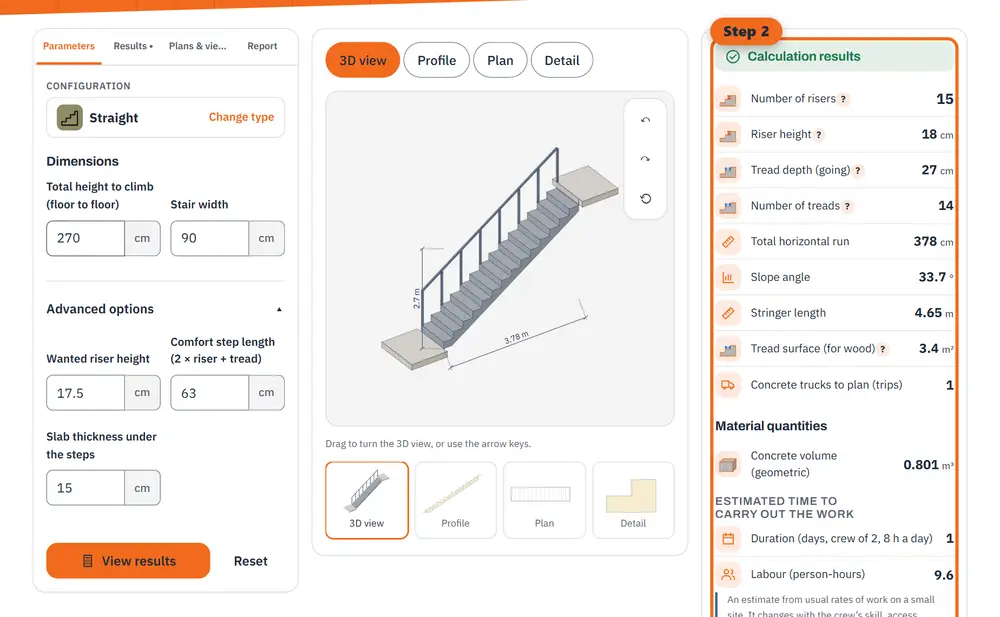
Step 2 Read the results: quantities, costs and estimated durations, updated as you type. 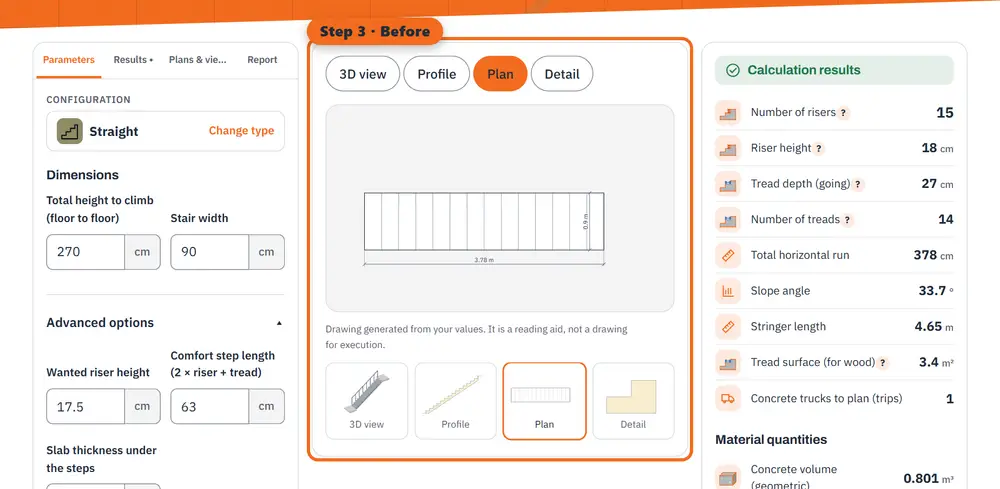
Step 3 Before: the plan of the work to be built, with its dimensions. 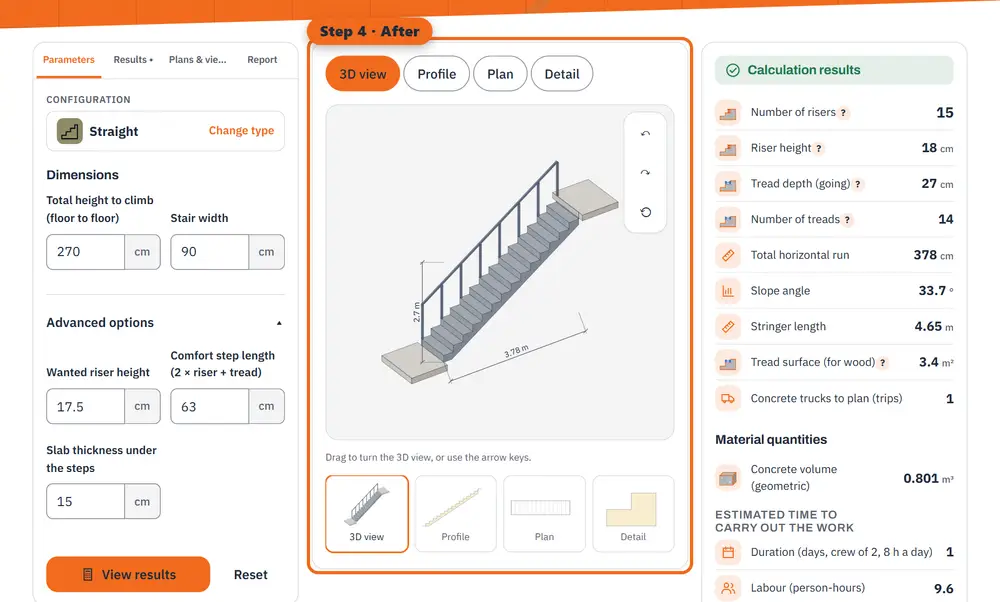
Step 4 After: the 3D rendering of the finished work (an illustration made by the tool, not a photo).
1. Measure the total rise
Measure from the finished floor below to the finished floor above, not from structure to structure. Floor finishes that are not laid yet change the height by several centimetres: allow for them. Include the thickness of the floor slab and its build-up.
2. Choose the number of risers
Divide the total rise by the riser height you want (often 16 to 18 cm) and round to the nearest whole number:
- Number of risers n = total rise H ÷ wanted riser height, rounded to a whole number.
- The number of treads is one less than the number of risers when the upper floor counts as the last step: n − 1.
3. Work out the actual riser height
The actual riser is the total rise divided by that whole number: r = H ÷ n. Every step in a flight is exactly the same height. Uneven risers are a classic cause of falls; the foot notices a difference of a few millimetres.
4. Derive the tread with Blondel’s formula
Blondel’s formula links comfort and stride length: 2 × riser + tread = 63 cm (about 59 to 65 cm is comfortable).
- Tread t = 63 − 2 × r.
- As a check: tread + riser is around 46 cm, and tread − riser around 12 cm.
- The steeper the stair, the shorter the tread: every extra centimetre of riser takes two centimetres off the tread.
5. Run, slope and stringer length
From the riser and the tread you get the figures you need for space and cutting:
- Horizontal run L = (n − 1) × tread.
- Slope angle α = arctan(riser ÷ tread).
- Stringer length = √(H² + L²).
Example 1: total rise 270 cm
270 ÷ 17.5 = 15.4, so 15 risers of 270 ÷ 15 = 18.00 cm. Tread = 63 − 2 × 18 = 27 cm.
- 14 treads of 27 cm: horizontal run of 378 cm.
- Slope: arctan(18 ÷ 27) ≈ 33.7°.
- Stringer length: √(270² + 378²) ≈ 465 cm (4.65 m).
- At 90 cm wide, about 3.4 m² of timber treads.
Example 2: total rise 285 cm, three options
With 285 cm you can choose the number of risers in several ways. The comparison shows why you should not round blindly:
- 15 risers: 19.00 cm, tread 25.0 cm, run 350.0 cm, slope 37.2°. Steep, with a tight tread.
- 16 risers: 17.81 cm, tread 27.4 cm, run 410.6 cm, slope 33.1°. A comfortable compromise.
- 17 risers: 16.76 cm, tread 29.5 cm, run 471.5 cm, slope 29.6°. Very gentle, but needs over a metre more length.
Common mistakes
- Measuring the rough height and forgetting the finishes above and below.
- Mixing up risers and treads: there is always one more riser than treads.
- Rounding to half a step: the number of risers must be whole.
- Building the first or last step differently because a finish is missing: it must be identical too.
- Looking only at the riser and leaving the tread too short.
- Not checking the headroom above the stair.
What the calculation does not cover: codes and structure
Building codes set limits on riser and tread, headroom, handrails, guards and landings, and they differ by country and building type (as a rough guide, a riser of at most 18 to 20 cm and a tread of at least 25 to 28 cm; check the rule that applies to your job).
The structure of the stair (slab, stringers, supports) is designed separately. The calculator gives a preliminary layout, not a verification or a working drawing.
Check it with the calculator
Enter the total rise, the riser height you want and the stride in the stair calculator: it returns the number and height of the risers, the tread, the run, the slope, the stringer length and the tread area. For pricing, the labour cost calculator turns hours and wages into a cost per unit.
General information, checked at the date shown. It does not replace advice from a professional for your situation.