What a construction quote must contain
A professional quote has four parts: the description of the work items (what is done and to what standard), the quantities (how much), the unit prices (what each unit costs) and the terms (what is included, what is not, timing and payment).
Clients compare quotes on clarity as much as on price: a precise, measured item builds trust and avoids disputes at the end of the job.
Using the tool step by step
The numbered marks on the screenshots follow the order in which you use the tool. The fields are filled with an example.
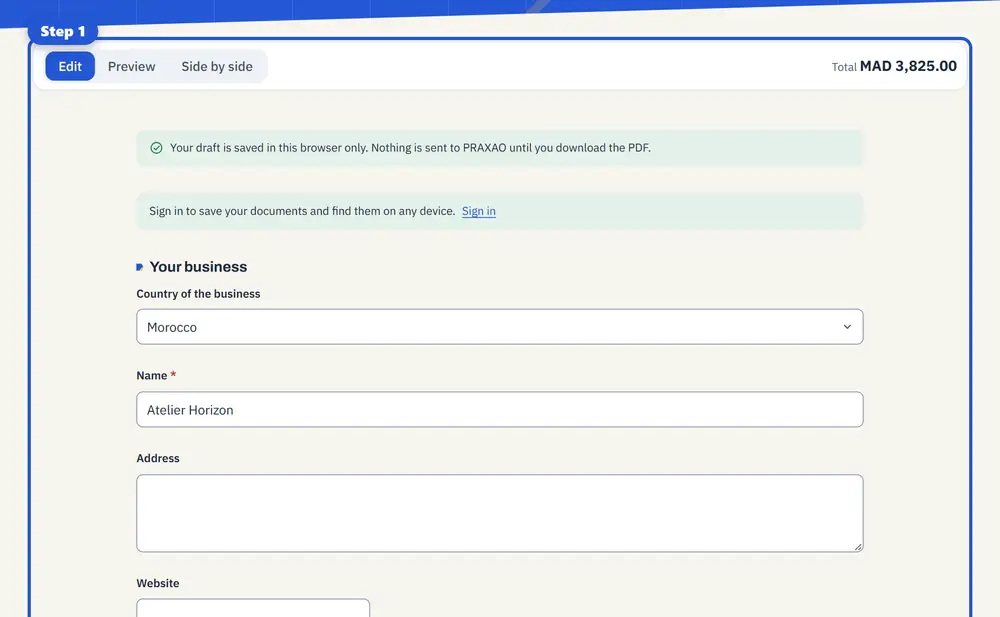
Step 1 Enter your values: dimensions, materials and options. 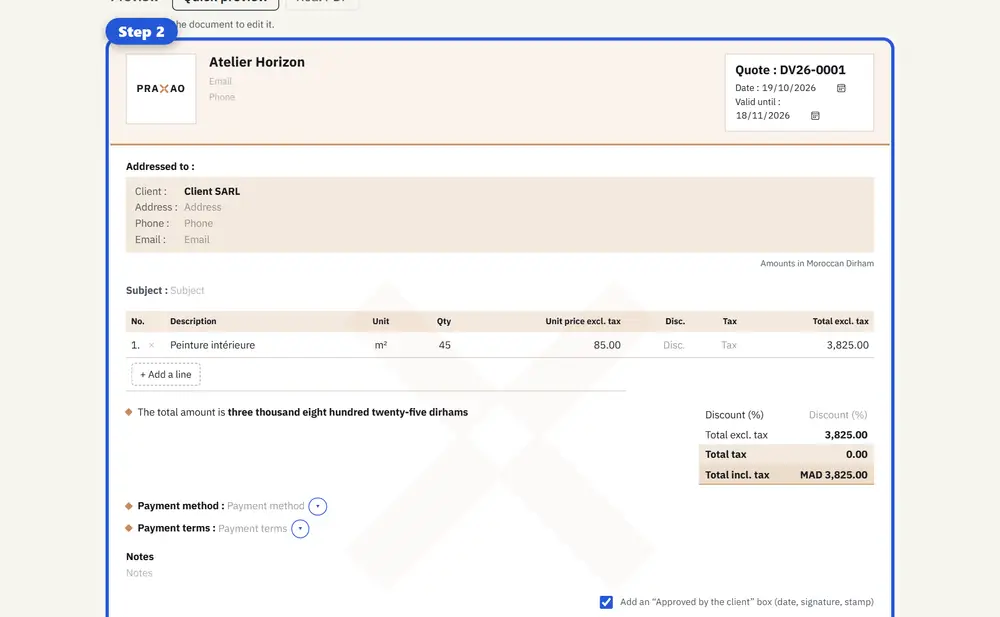
Step 2 Check the preview of the document as it will be sent. 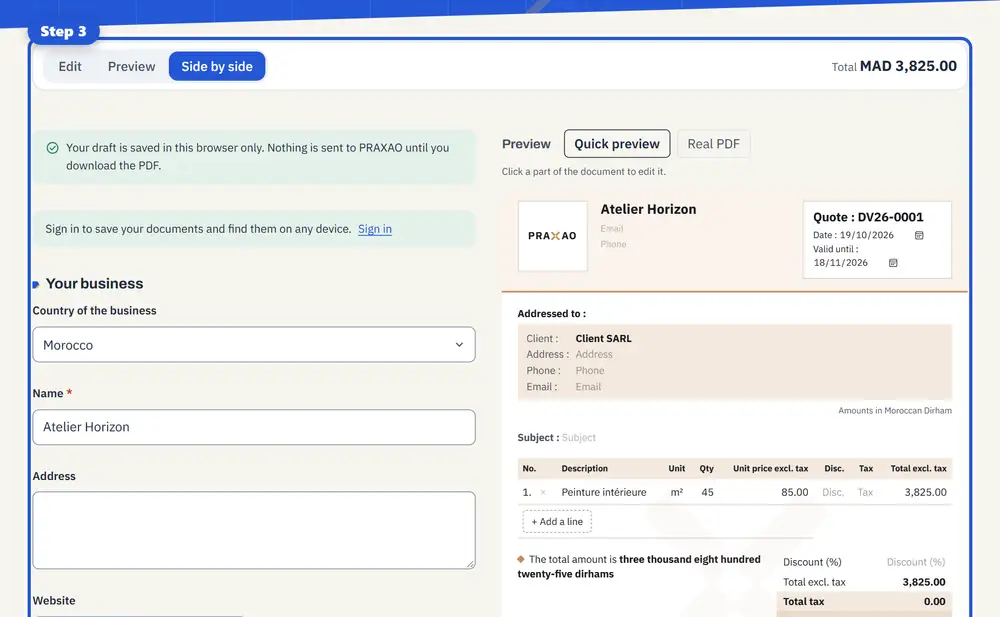
Step 3 Edit the fields and watch the document update side by side.
1. Break the job into trades and work items
Split the job into trades, and each trade into work items with a unit of measure. A work item is a unit of work that can be measured and billed separately.
- Demolition and rubble removal (m², m³ or each).
- Masonry and structure (m³ of concrete, m² of wall).
- Services: plumbing and electrical (points or each).
- Finishes: tiling, flooring, plaster and paint (m²).
- Joinery, sanitary ware and fittings (each).
- Final cleaning and waste handling.
2. Measure: the foundation of everything
Almost every quoting error starts with a careless take-off. Measure on site, write down the dimensions and use simple formulas:
- Wall area = perimeter × height − openings (doors and windows).
- Floor or ceiling area = length × width.
- Volume = length × width × thickness.
- Quantity to buy = measured quantity × (1 + waste). Indicative waste: 5 % for concrete and mortar, 10 % for tiles, 10–15 % when there are many cuts.
3. Work out the direct cost of each item
The direct unit cost is what it costs to do one unit of the item:
- Materials at purchase price, including waste.
- Labour: hours per unit × hourly cost including payroll charges.
- Plant, hire and consumables.
- Transport, storage and difficult access.
4. Overheads, contingency and margin
Three layers are added to the direct cost, always in this order:
- Overheads (vehicle, insurance, office, time spent quoting): between 10 % and 20 % of the direct cost depending on your business.
- Contingency (hidden conditions, finish changes): 3–5 % on new work and more when renovating old buildings.
- Margin or profit: calculated on the selling price, not on the cost.
The price formula
Price = (direct cost + overheads + contingency) ÷ (1 − margin). With a 15 % margin you divide by 0.85; you do not multiply by 1.15. The difference is money you fail to earn without noticing.
Complete example: renovating a 2.5 × 2.0 m bathroom
Measurements: floor 2.5 × 2.0 = 5 m². Walls: perimeter 2 × (2.5 + 2.0) = 9 m; at 2.4 m high that is 21.6 m², minus 1.6 m² for the door = 20 m². Unit prices are illustrative: replace them with your own.
- Strip tiles and floor: 25 m² × 12.00 = 300.00
- Rubble removal (skip): 1 each × 180.00 = 180.00
- Plumbing (drains and valves): 1 each × 650.00 = 650.00
- Wall tiling: 20 m² × 48.00 = 960.00
- Floor tiling: 5 m² × 52.00 = 260.00
- Sanitary ware and screen: 1 each × 780.00 = 780.00
- Ceiling paint: 5 m² × 9.00 = 45.00
From cost to selling price, with numbers
Direct cost: 3,175.00. Overheads at 12 %: 381.00. Contingency at 5 % of the direct cost: 158.75. Total cost: 3,714.75.
With a 15 % margin on the price: 3,714.75 ÷ 0.85 = 4,370.29 (profit 655.54), before tax. Multiplying by 1.15 would give 4,271.96 and your real margin would be only 13.0 %.
With a 30 % deposit at signing, the client pays 1,311.09 up front.
Common mistakes that cost money
- Forgetting small items: rubble removal, protection, cleaning and travel.
- Measuring from drawings without checking on site.
- Using a material price without adding waste.
- Applying the margin to the cost instead of the selling price.
- Not separating what is included from what is excluded: every later change ends in an argument.
- Pricing labour by eye, without hours per unit or payroll charges.
- Not stating how long the offer is valid: material prices move.
Terms that protect the contractor and the client
- Description of each item with its quality and brand or equivalent.
- What is not included (permits, furniture, unforeseen hidden conditions).
- Completion time and start date.
- Validity of the offer (30 days is common).
- Payment terms: deposit at signing (often 30 %), progress payments and balance on completion.
- Variations: priced and accepted in writing before they are carried out.
- Taxes: say whether prices include VAT or sales tax; the rate depends on the country and the type of work, check it with your adviser.
- Client signature and acceptance date.
Doing it with PRAXAO and BUILIVA
Work out the quantities of each item with the BUILIVA calculators (paint, tiles, walls, screed…), with waste in plain view, then carry the result into the PRAXAO quote generator: items, totals, validity and deposit in a PDF ready to send.
Results are estimates based on the assumptions you enter; they do not replace a contractual take-off or the judgement of a professional.
General information, checked at the date shown. It does not replace advice from a professional for your situation.