1. Cost of a site mix
Cement bags: the cement per m³ times the volume, divided by the weight of a bag and rounded up, times the price of a bag. Add the sand and the gravel (their volume per m³ of concrete times the volume of the pour, times their price per m³) and the mixing labour per m³.
Using the tool step by step
The numbered marks on the screenshots follow the order in which you use the tool. The fields are filled with an example.
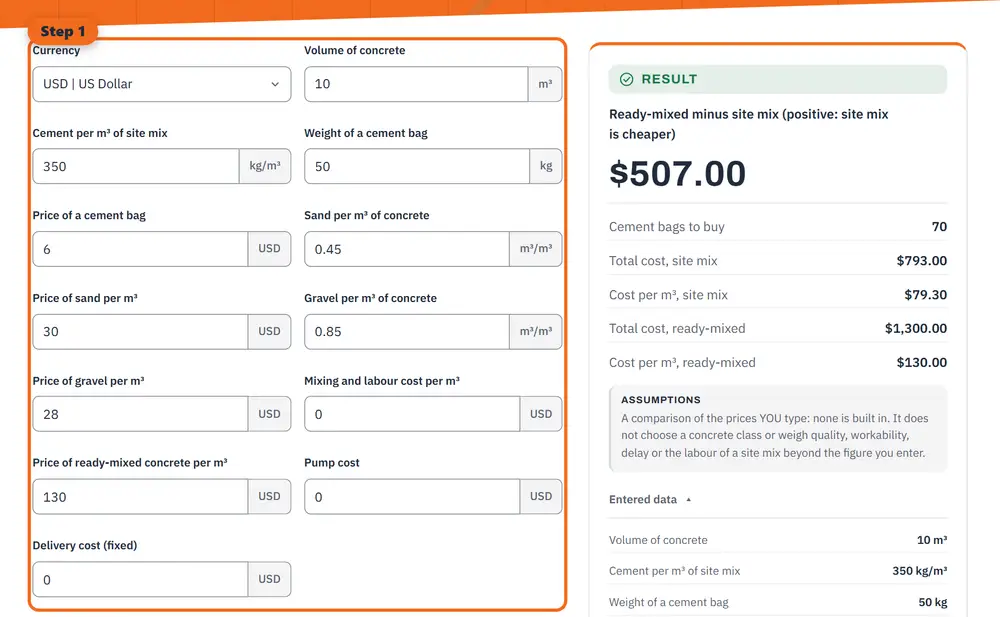
Step 1 Enter your values: dimensions, materials and options. 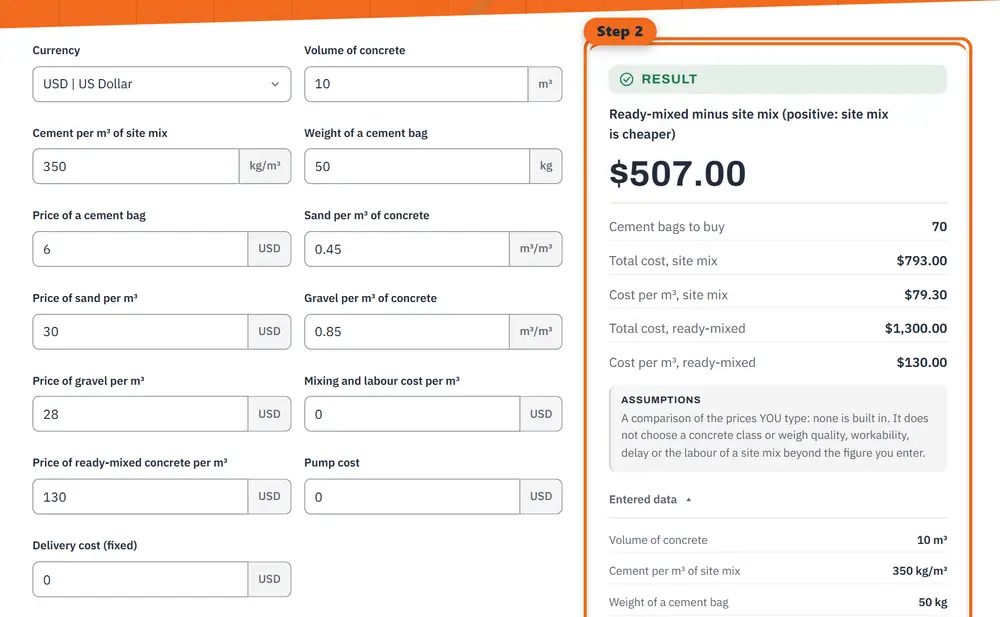
Step 2 Read the results: quantities, costs and estimated durations, updated as you type. 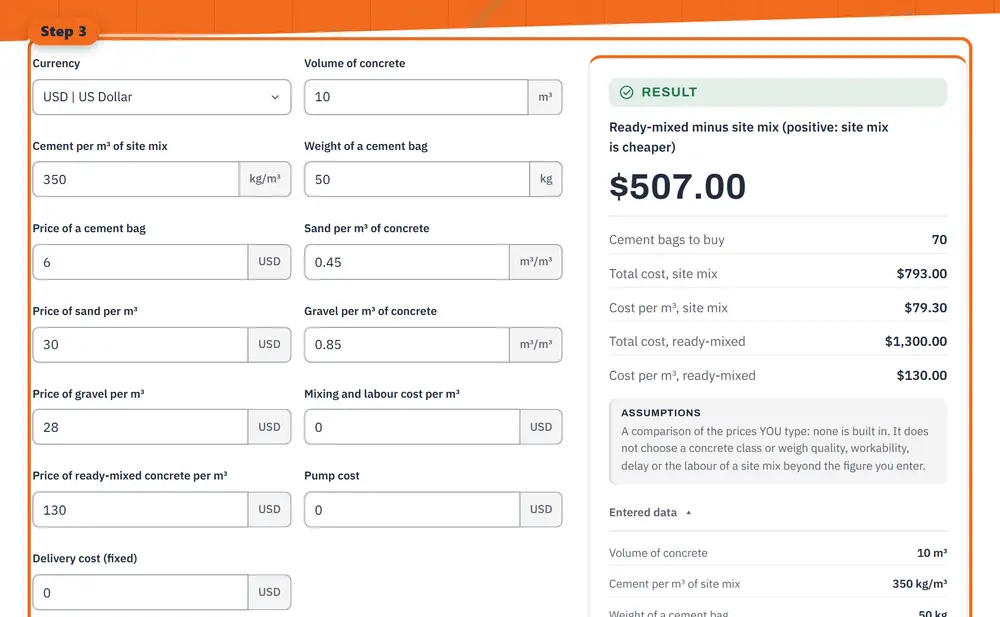
Step 3 Print, copy the result or save it as a PDF.
2. Cost of ready-mixed concrete
The price per m³ times the volume, plus the pump if one is needed and the delivery charge, which is often a fixed amount.
Worked example with illustrative prices: 10 m³
Mix of 350 kg of cement, 0.45 m³ of sand and 0.85 m³ of gravel per m³. Prices typed for the example: bag 60, sand 180 per m³, gravel 220 per m³, labour 120 per m³; ready-mixed 900 per m³, pump 800, delivery 300:
- Cement: 10 × 350 / 50 = 70 bags × 60 = 4 200.
- Sand 4.5 m³ × 180 = 810. Gravel 8.5 m³ × 220 = 1 870. Labour 10 × 120 = 1 200.
- Site mix: 8 080, i.e. 808 per m³.
- Ready-mixed: 10 × 900 + 800 + 300 = 10 100, i.e. 1 010 per m³. Difference 2 020.
What the comparison leaves out
It compares costs only. Quality control, workability, the strength class, the delay, storage on site and the equipment you have are for you and the engineer to weigh. A small pour may not justify a delivery charge; a large one rarely suits a site mixer.
Why no prices are built in
Prices change with the place, the supplier and the date. The tool uses the ones you type, so the result reflects your own situation and nothing is guessed.
General information, checked at the date shown. It does not replace advice from a professional for your situation.