1. The area really redone
Multiply the total surface by the share you redo. Everything that follows is counted on that area.
Using the tool step by step
The numbered marks on the screenshots follow the order in which you use the tool. The fields are filled with an example.
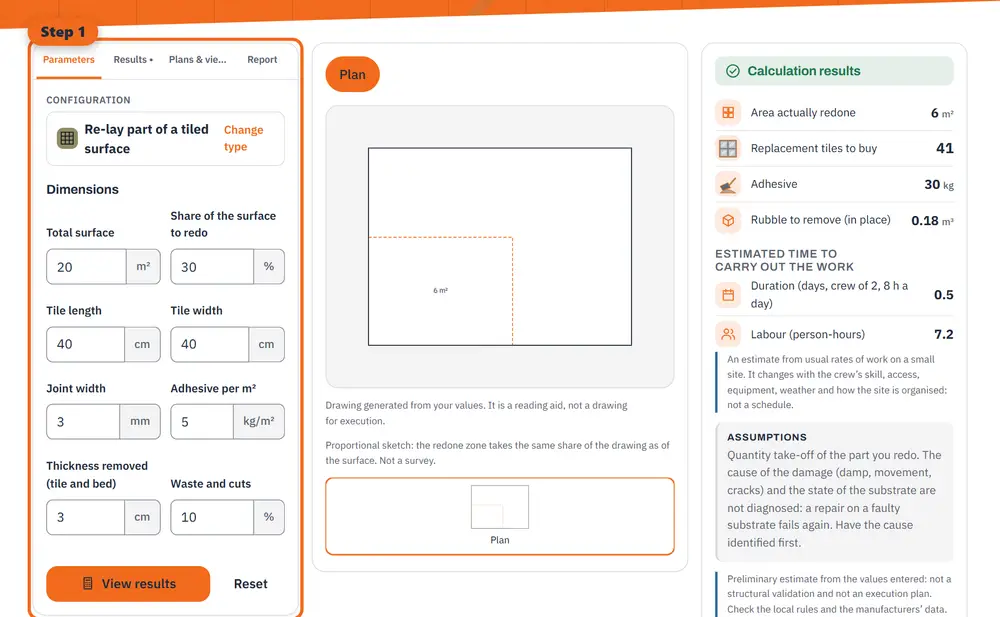
Step 1 Enter your values: dimensions, materials and options. 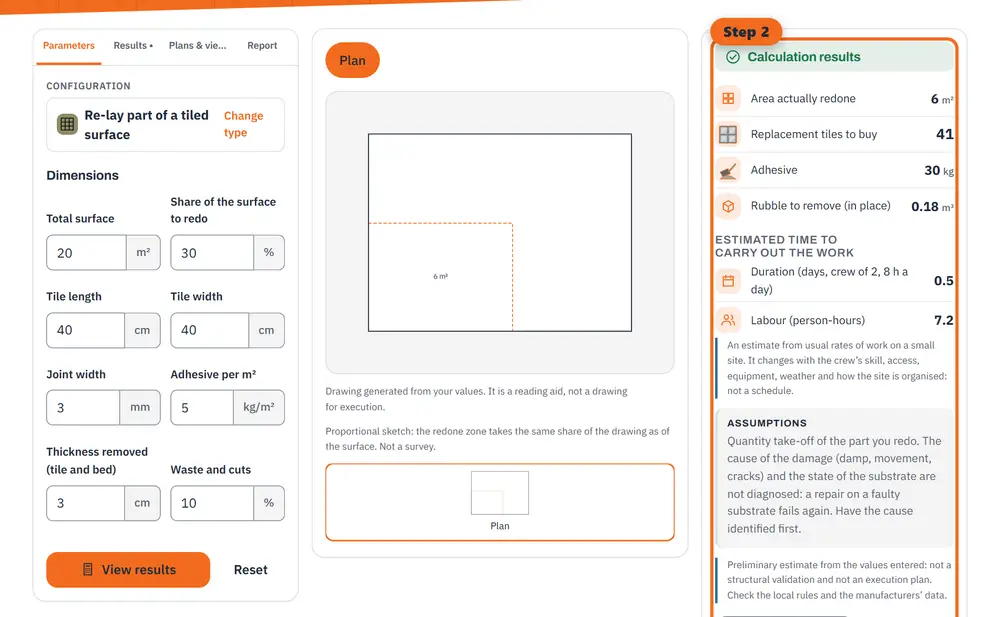
Step 2 Read the results: quantities, costs and estimated durations, updated as you type. 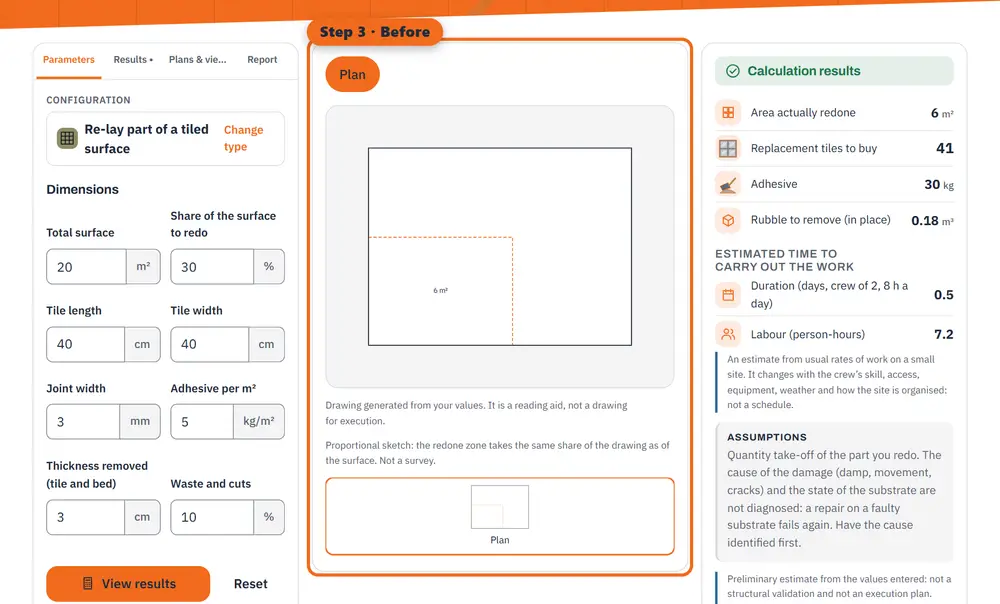
Step 3 Before: the plan of the work to be built, with its dimensions.
2. Tiles, plaster, paint
Tiles: the area with waste divided by the area of a tile with its joint, rounded up; adhesive per m²; rubble from the thickness removed. Plaster: the area times the thickness times the consumption per m² per mm, with waste, divided by the weight of a bag. Paint: the area with waste times the coats, divided by the coverage; the primer the same way.
Worked example: 25 % of a tiled floor of 40 m²
Tiles of 40 × 40 cm, 3 mm joints, 10 % waste, adhesive 5 kg/m², 3 cm removed:
- Area redone 40 × 25 % = 10 m².
- Tile with joint 0.403 × 0.403 = 0.162409 m². Tiles: 10 × 1.10 / 0.162409 = 67.7, so 68.
- Adhesive 10 × 5 = 50 kg. Rubble 10 × 0.03 = 0.300 m³.
Plaster and paint
30 % of 50 m² of plaster 15 mm thick at 1.4 kg/m²/mm, 25 kg bags, 10 % waste; then 120 m² repainted with 2 coats at 10 m²/L, 1 primer coat, cans of 10 L:
- Plaster: 15 m², volume 15 × 0.015 = 0.225 m³; 15 × 15 × 1.4 = 315 kg, with waste 346.50 kg, so 14 bags.
- Paint: 132 m² with waste × 2 / 10 = 26.40 L; primer 13.20 L; 3 cans of paint.
What this does not cover
The count does not find the cause of the damage (damp, movement, cracks) or judge the substrate. A repair on a faulty substrate fails again: have the cause identified first.
General information, checked at the date shown. It does not replace advice from a professional for your situation.