The formulas
All amounts before tax:
- Gross profit = selling price − cost.
- Margin (%) = gross profit ÷ selling price × 100.
- Markup (%) = gross profit ÷ cost × 100.
- Multiplier = selling price ÷ cost (1.5 means the price is 1.5 times the cost).
Using the tool step by step
The numbered marks on the screenshots follow the order in which you use the tool. The fields are filled with an example.
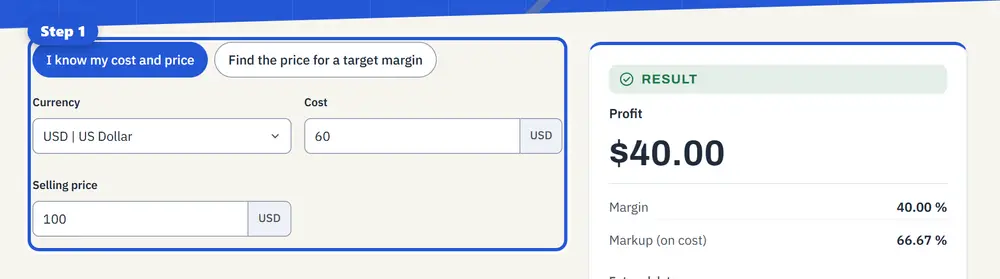
Step 1 Enter your values: dimensions, materials and options. 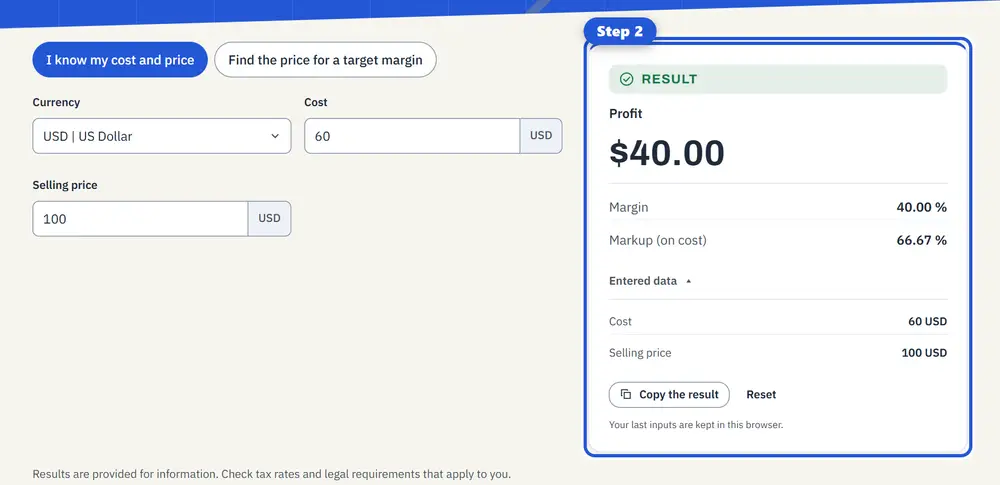
Step 2 Read the results: quantities, costs and estimated durations, updated as you type. 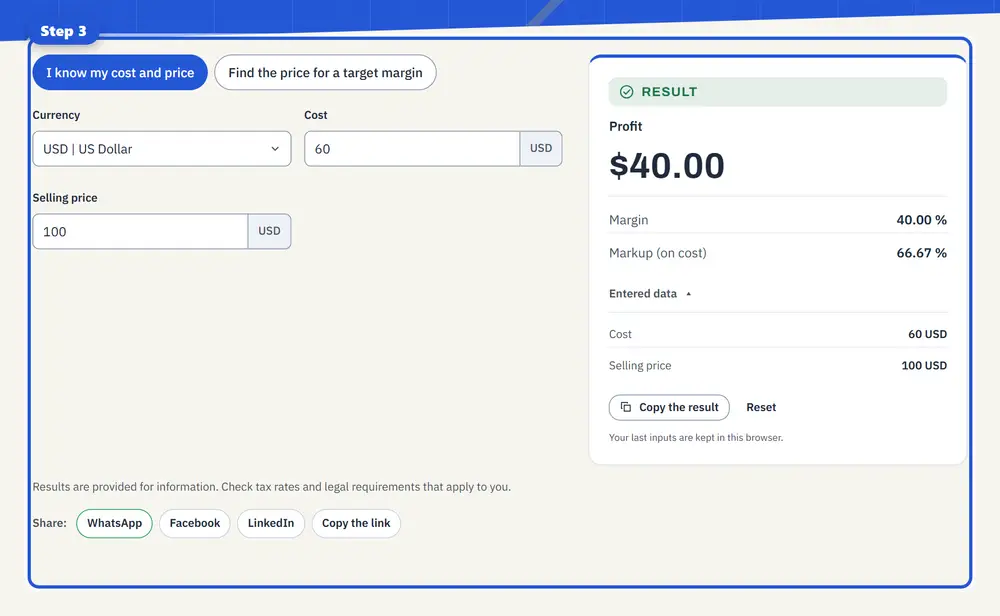
Step 3 Print, copy the result or save it as a PDF.
Worked example
An item costs 60 and sells for 100: the profit is 40. The margin is 40 ÷ 100 = 40 %, the markup is 40 ÷ 60 = 66.7 %, and the multiplier is 1.667. Same profit, three different numbers.
Pricing for a target margin
To earn a given margin on the selling price, divide the cost by (1 − margin): for a 30 % margin on a cost of 70, the price is 70 ÷ 0.70 = 100.
The common mistake is to add 30 % to the cost: 70 × 1.30 = 91 gives only a 23 % margin. Over a year of sales, the difference is large.
Discounts and break-even
A discount comes off the selling price, so it eats the margin quickly: with a 40 % margin, a 10 % discount removes a quarter of the profit. Check the margin left after a discount before granting it.
To know how much you must sell to cover your fixed costs, use the break-even calculator. Margins here are gross: overheads, taxes and your own pay still have to be covered.
General information, checked at the date shown. It does not replace advice from a professional for your situation.