1. Stone and zellige: pieces with joints
A piece takes its own size plus one joint on each axis. Divide the area, increased by the waste, by that area and round up. Adhesive and grout are counted per square metre at the maker’s rate.
Using the tool step by step
The numbered marks on the screenshots follow the order in which you use the tool. The fields are filled with an example.
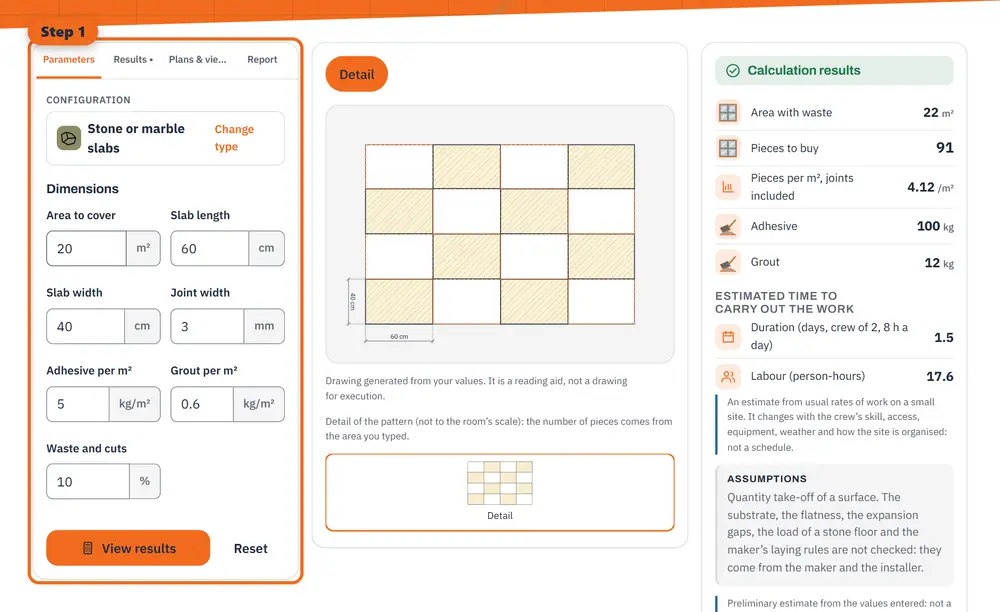
Step 1 Enter your values: dimensions, materials and options. 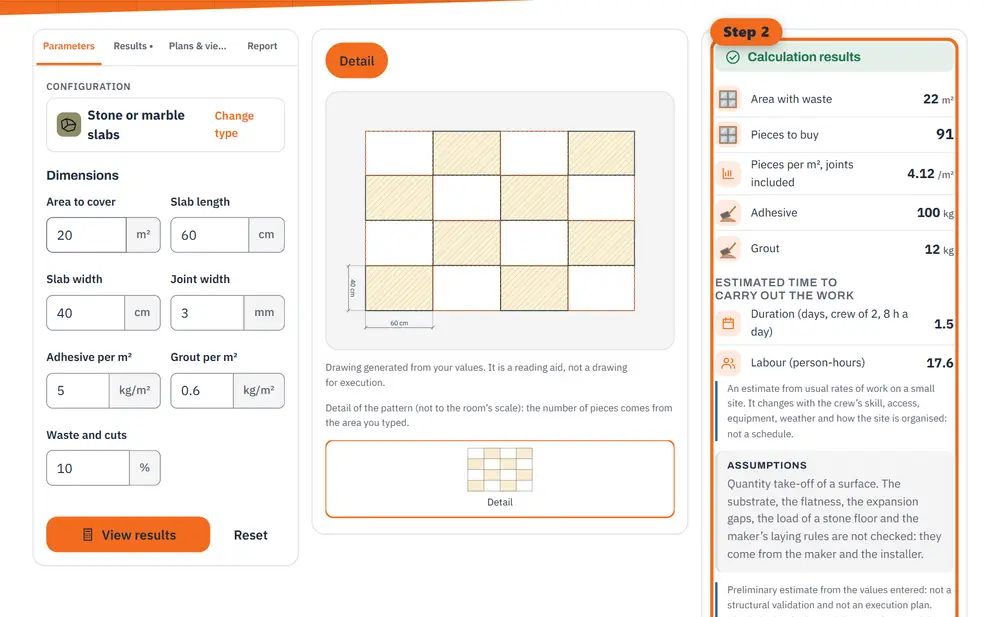
Step 2 Read the results: quantities, costs and estimated durations, updated as you type. 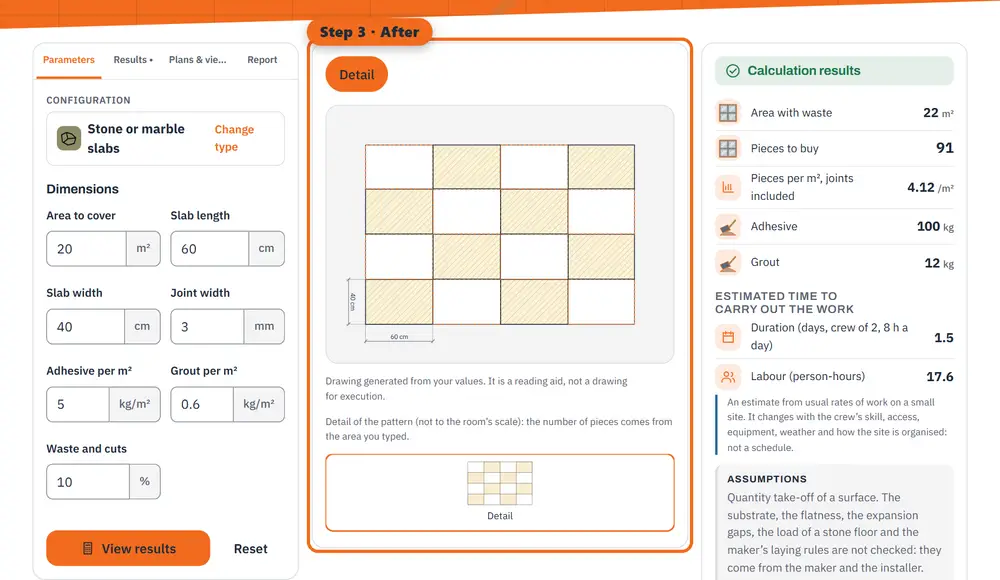
Step 3 After: the 3D rendering of the finished work (an illustration made by the tool, not a photo).
2. Parquet: boards, packs, underlay, skirting
Divide the area with waste by the area of a board for the boards, and by the coverage of a pack for the packs. The underlay covers the area plus its overlaps. The skirting is the perimeter divided by the length of a bar.
Worked example: 30 m² of stone 60 × 40 cm, 3 mm joints
Waste 10 %, adhesive 5 kg/m², grout 0.6 kg/m²:
- Piece with joints 0.603 × 0.403 = 0.243009 m².
- Area with waste 30 × 1.10 = 33.00 m². Pieces: 33 / 0.243009 = 135.8, so 136.
- Adhesive 30 × 5 = 150.00 kg. Grout 30 × 0.6 = 18.00 kg.
Zellige and parquet
6 m² of 10 cm zellige with 2 mm joints and 10 % waste, then 25 m² of parquet in boards of 14 × 120 cm, packs of 2.2 m², 20 m of perimeter:
- Zellige: piece 0.102² = 0.010404 m², 6 × 1.10 / 0.010404 = 634.4, so 635 pieces.
- Parquet: area with waste 27.50 m²; boards 27.5 / 0.168 = 163.7, so 164; packs 27.5 / 2.2 = 12.5, so 13.
- Underlay 25 × 1.05 = 26.25 m². Skirting 20 / 2.4 = 8.33, so 9 bars.
What this does not cover
The count does not check the substrate, the flatness, the expansion gaps or the load of a stone floor. These come from the maker and the installer.
General information, checked at the date shown. It does not replace advice from a professional for your situation.